A water softener replacement makes sense when repairs become expensive, failures repeat, or the existing unit no longer controls hardness. Age matters, but the failed component matters too. A well-maintained system with a repairable valve may still deserve service instead.
Direct answer: Most homeowners should consider replacement when their unit reaches roughly 10 years and develops recurring problems. Current U.S. cost guides place many installed replacements near $1,500, although system type and labor can move costs substantially. Repairing a younger unit can still be economical when the problem is isolated.
Replacement Planning at a Glance
| Question | Practical guidance |
|---|---|
| Typical lifespan | Many units last about 10–15 years, although design and maintenance matter |
| Common warning signs | Returning scale, weak performance, leaks, pressure changes, repeated regeneration |
| Typical installed cost | Around $1,500 is a current national reference point |
| Repair first? | Usually sensible for younger systems with one identifiable failure |
| Replace first? | More compelling for older units with repeated or expensive failures |
| DIY possible? | Sometimes, when plumbing connections match and local requirements allow |
| Re-size before buying? | Yes, especially after household or water conditions change |
Current manufacturer guidance places some residential units around an 8–10 year average lifespan. Other cost sources report longer service lives across broader equipment types. Treat age as one decision factor rather than an automatic replacement date.
Key Takeaways
- Start by confirming that the problem is not salt bridging, settings, or another simple issue.
- Compare repair cost against the installed price of a correctly sized replacement.
- Repeated failures make replacement more attractive, especially on older equipment.
- Test hardness before selecting capacity for the next system.
- Check household demand instead of automatically buying the old capacity again.
- Professional installation can reduce risk when plumbing changes are needed.
- Our shower diverter guide covers another common plumbing fix around the home.
When Water Softener Replacement Makes More Sense Than Repair
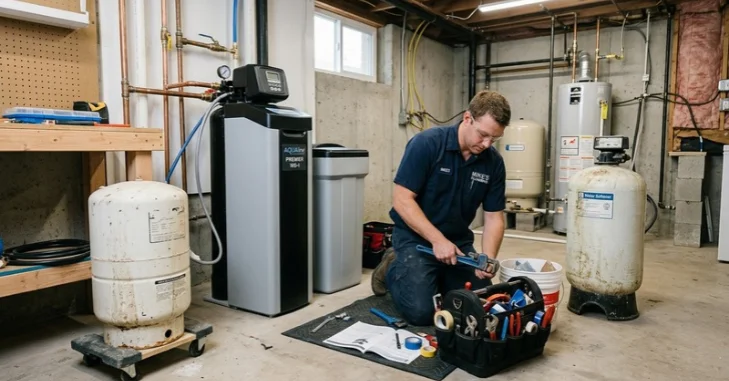
Water Softener Replacement becomes more reasonable when several warning signs appear together. Returning scale, poor soap performance, pressure changes, or frequent regeneration can signal declining performance. One symptom alone still deserves basic troubleshooting before buying new equipment.
Cost also changes the decision. Angi reports repair costs from roughly $160 to $980, depending on the problem. Its guidance suggests replacement when repair approaches half the price of a new system.
A newer system with one replaceable component may be worth repairing. An older unit with repeated valve, motor, or resin problems presents a different equation. Parts availability should also affect your decision.
Seven Signs Your Existing System May Be Near the End
Homeowners often notice water changes before they notice equipment failure. Watch for several symptoms occurring repeatedly after normal maintenance. Those patterns provide stronger evidence than age alone.
- Scale starts returning. White mineral deposits reappear on faucets, shower glass, or fixtures.
- Soap performs poorly. Shampoo, detergent, or dish soap becomes harder to lather.
- Regeneration happens too often. The unit cycles more frequently without an obvious demand change.
- Salt use rises sharply. Frequent refilling can indicate settings, leaks, or declining efficiency.
- Water pressure drops. Valve, resin, or internal flow problems may restrict water movement.
- Repairs keep returning. Repeated service calls can make replacement more economical.
- The unit leaks or has structural damage. Tank or fitting problems deserve immediate inspection.
Manufacturer and service guidance identify increased salt use, frequent regeneration, and reduced performance as common replacement signals. Hard-water symptoms may also appear on dishes, laundry, fixtures, or skin.
How Much Does Replacement Cost in the United States?
Current national estimates vary because equipment and installation needs differ widely. ConsumerAffairs reports an average near $1,500 for replacing a system. Its broader reported range extends from hundreds to several thousand dollars.
The equipment type creates much of that spread. Single-tank ion-exchange equipment generally costs less than larger dual-tank configurations. Plumbing changes, electrical work, disposal, permits, and regional labor can raise the total.
Ask for an itemized quote before comparing contractors. Separate equipment, labor, fittings, disposal, testing, and optional filtration. That structure makes competing estimates easier to evaluate.
Repair or Replace: A Practical Cost Comparison
| Situation | Repair is usually stronger | Replacement is usually stronger |
|---|---|---|
| Unit age | Younger equipment | Older equipment with repeated issues |
| Failure type | Isolated, replaceable component | Multiple failures or structural damage |
| Parts | Easy to source | Proprietary or unavailable |
| Repair price | Small share of replacement cost | Near half of replacement cost |
| Performance history | Reliable until one recent fault | Declining for months or years |
| Sizing | Still matches household demand | Household or water conditions changed |
Use the table as a screening tool, not a strict rule. An expensive premium valve can justify repair beyond a simple percentage threshold. A low-cost proprietary unit may justify earlier replacement when major parts fail.
The best decision compares total future cost. Include likely repairs, remaining service life, salt use, and installation work. That gives a clearer picture than comparing equipment prices alone.
How to Size the New System Correctly
Do not assume your old capacity is still right. Household size, water use, hardness, and iron levels can change over a decade. Test your current water before ordering equipment.
Hardness is commonly expressed in grains per gallon. Capacity selection should reflect hardness and expected household demand. Well-water homes may also need testing for iron or other conditions.
Oversizing can waste money, while undersizing can cause frequent cycling. A properly sized metered unit regenerates according to actual demand. That can improve operating efficiency and reduce unnecessary salt and water use.
What the Replacement Process Usually Involves
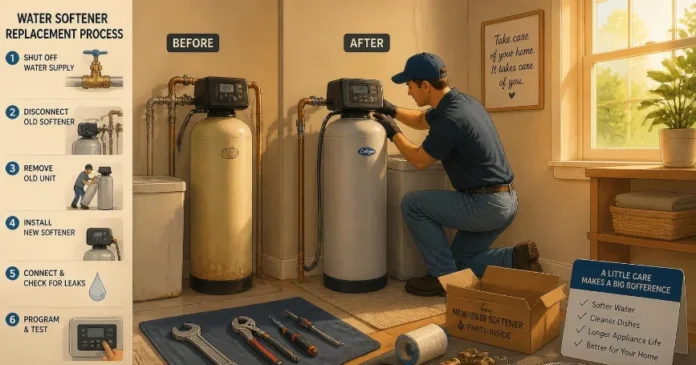
The basic sequence is straightforward when existing plumbing matches the new equipment. Manufacturer instructions still take priority because connection designs vary. Local plumbing requirements can also affect installation.
- Place the old unit in bypass according to its instructions.
- Shut off the home’s main water supply.
- Open downstream fixtures to relieve pressure.
- Disconnect the old bypass, drain, and overflow connections.
- Remove the existing tanks and clean the installation area.
- Position the replacement unit with service clearance.
- Connect inlet, outlet, drain, overflow, and bypass components.
- Restore water slowly and inspect every connection.
- Program hardness, capacity, time, and regeneration settings.
- Run the manufacturer’s startup or regeneration procedure.
Rheem and Whirlpool both instruct homeowners to depressurize plumbing before disconnecting replacement equipment. Their procedures also show that connection details depend on the specific model. Always follow the manual supplied with your new equipment.
Should You Replace It Yourself?
DIY can work when the replacement uses compatible plumbing and the installation area is accessible. The job becomes harder when pipe sizes, drain locations, or bypass assemblies change. Heavy resin tanks can also be difficult to move safely.
Consider professional installation when significant plumbing modification is required. A plumber can also verify bypass orientation, drain routing, pressure, and leak-free connections. Local codes may require specific drain or backflow arrangements.
Homeowners planning basement mechanical work can also read about checking a damp basement for mold. Moisture and mineral problems often show up in the same below-grade spaces.
Replacement Is Also a Good Time to Review Water Quality
A softening system addresses hardness minerals, not every water-quality problem. Odor, chlorine, sediment, iron, or other contaminants can require separate treatment. Testing helps prevent buying equipment that solves the wrong problem.
The U.S. EPA notes that ion-exchange softeners remove hardness minerals such as calcium and magnesium. EPA also highlights regeneration water use when discussing efficient equipment selection. Choose equipment around the actual water condition rather than marketing claims.
Think about nearby appliances during the project as well. Scale can affect water-heating equipment and fixtures over time. Livingia’s air conditioner maintenance checklist shows how seasonal upkeep planning works for another major appliance.
How to Make the New System Last Longer
Routine maintenance starts with using the correct salt and checking the brine tank. Break up salt bridges when they appear and keep the equipment area dry. Follow manufacturer instructions for cleaning and regeneration settings.
Avoid waiting for obvious failure before checking performance. Periodically compare water feel, visible scale, and tested hardness with normal conditions. Early changes can reveal settings or maintenance problems before major repairs develop.
Keep the model number, installation date, settings, and service history together. Those records simplify future troubleshooting and warranty claims. They also help the next homeowner understand the equipment.
The Bottom Line
A water softener replacement should follow diagnosis, not frustration. Confirm the failure, compare repair economics, and test current hardness before selecting new equipment. Those steps reduce the chance of replacing a repairable unit or buying the wrong size.
For older equipment with recurring problems, replacement can provide a cleaner long-term path. Use documented water conditions and an itemized installation quote before committing. Pair this project with other plumbing upkeep, such as a shower diverter check, while the water is already shut off.
Frequently Asked Questions
How long does a softener usually last?
Many residential units operate for about 10–15 years, but service life varies. Some manufacturers cite an 8–10 year average for specific product lines. Maintenance, water conditions, and equipment design can shorten or extend that period.
What is the average cost of water softener replacement?
A current U.S. reference point is about $1,500 installed. Prices can run lower or much higher depending on system type and labor. Get local quotes because plumbing conditions and regional rates vary.
Is a ten-year-old unit automatically ready for replacement?
No, age alone does not prove replacement is necessary. A serviceable system with one inexpensive failure may still have useful life. Repeated problems and high repair costs strengthen the replacement case.
Can I reuse the existing plumbing connections?
Sometimes, especially when the replacement has compatible inlet, outlet, and bypass dimensions. Never assume the fittings will match before checking both manuals. Adapters or plumbing changes may still be necessary.
Should I buy the same capacity again?
Not automatically. Retest hardness and reconsider household demand before choosing capacity. A decade of household changes can make the previous size inappropriate.